

Google quietly published something in its Search Central documentation that most business owners will never hear about, and a small group of them should act on immediately.
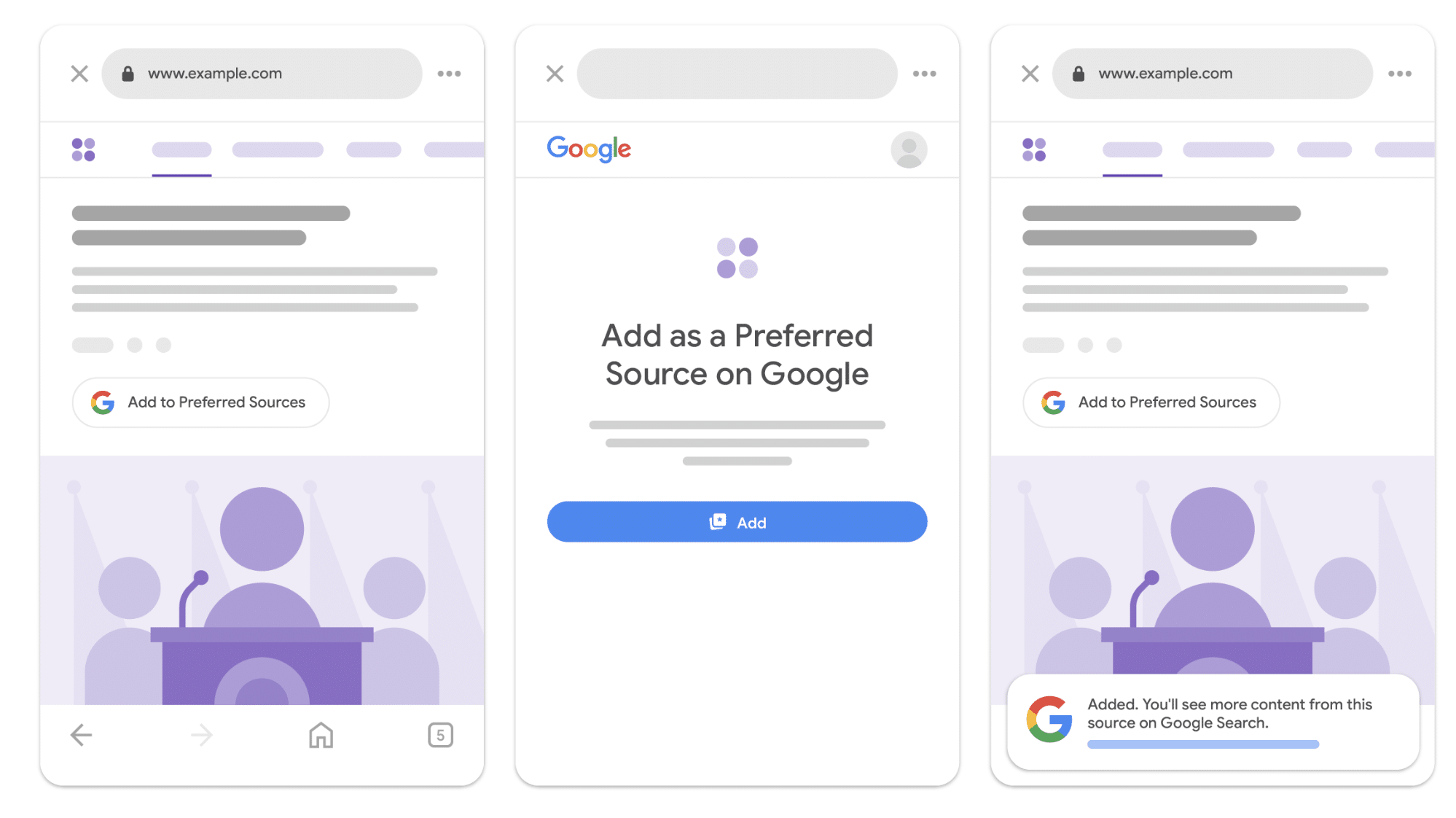
It’s called Preferred Sources, and it lets a person tell Google, ‘when there’s news about this topic, show me this publication first.’ Google now gives website owners official code to add a button to their own site so visitors can make that choice in one click.
Here’s the part that matters: this is not a ranking hack. It’s a loyalty signal. And loyalty signals only pay off for businesses that have actually earned an audience.
Let’s break down what it does, who should care, and who can safely ignore it.
What Google Preferred Sources actually does
When a user selects your site as a preferred source, two things happen:
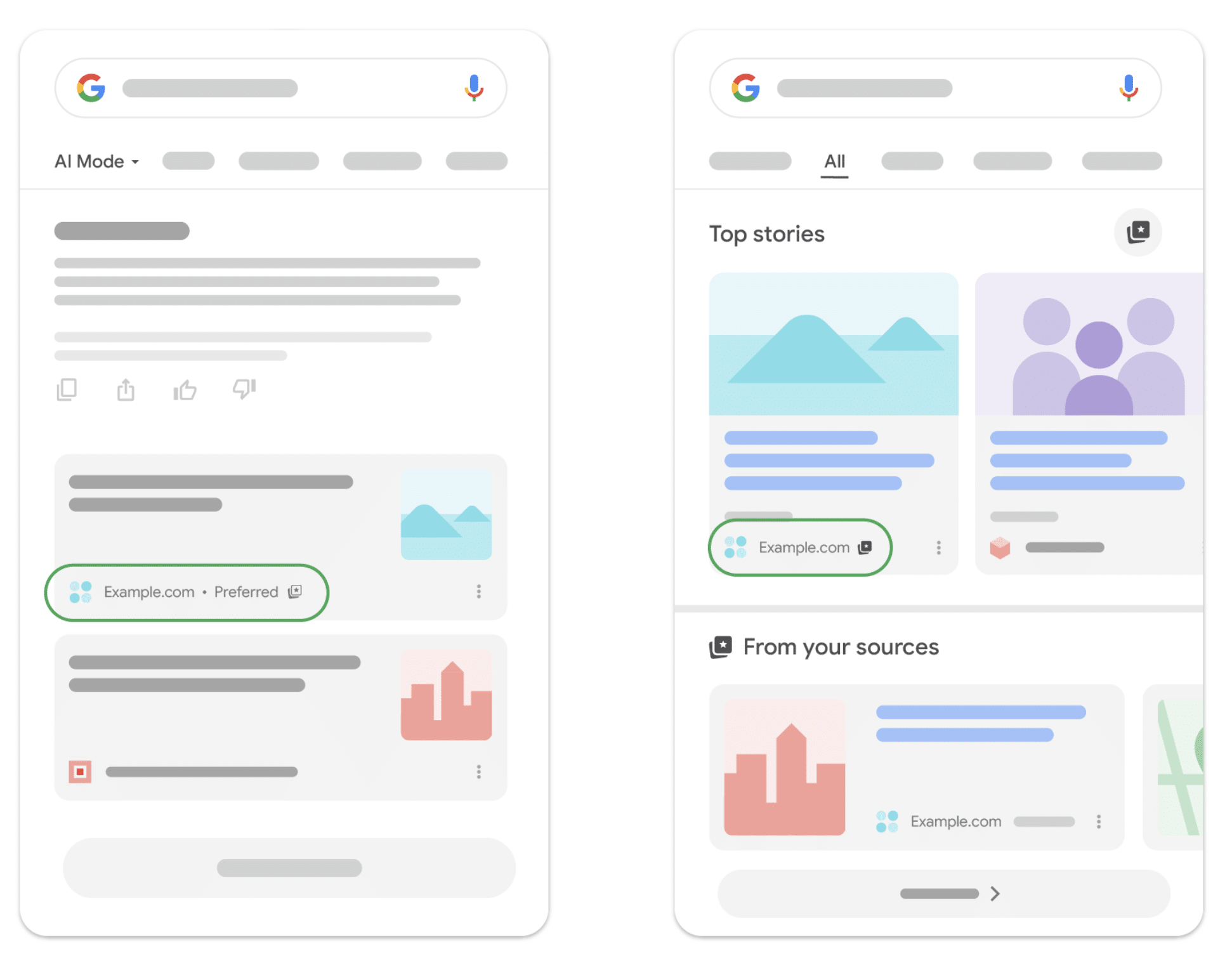
- Your content becomes more likely to appear in Top Stories for relevant news queries, for that specific user.
- Your citations get a ‘Preferred’ badge in AI Overviews and AI Mode, making your links visually stand out in AI-generated answers.
The second point deserves a caveat, because a lot of the coverage has gotten it wrong. The badge does not get you into an AI answer you weren’t already qualified to appear in. It highlights citations you already earned. Preferred status changes how you’re presented, not whether you’re included.
Google has said repeatedly that when someone picks a preferred source, they click through to that site roughly twice as much on average. Take that number with appropriate salt, since Google hasn’t published the baseline or how long the effect lasts. Directionally, though, it makes sense. You’re being surfaced to someone who explicitly asked for you.
Adoption has moved fast. Google reported nearly 90,000 unique sources selected in December 2025, more than 345,000 by late May 2026, and more than 600,000 as of August 2026. Worth noting what that figure measures: unique sources chosen, not users doing the choosing. One reader picking your site counts the same as a million readers picking it. It’s a measure of how wide the long tail has spread, not how deep adoption goes.
The uncomfortable truth: most businesses shouldn’t bother
Preferred Sources is tied primarily to Top Stories, a search feature that appears on news-driven, time-sensitive queries. If your customers don’t search for you in a news context, the ranking benefit has nowhere to land.
And the button itself requires something most sites don’t have: someone who likes you enough to click it. There is no algorithm you can optimize here. A visitor has to voluntarily raise their hand. If your site’s traffic is 95% first-time visitors who found you through one transactional search and never return, that button will collect dust.
Who genuinely benefits?
- News publishers and local news outlets. The intended audience, full stop.
- Trade and industry publications. B2B verticals where readers follow specific outlets for regulatory and market news.
- Financial advisors, wealth managers, and accounting firms publishing market commentary or tax-law updates. These are inherently news-adjacent queries with real recurring readership.
- Law firms covering regulatory change. Employment law, immigration policy, healthcare compliance. When a rule changes, Top Stories fires.
- Healthcare systems and medical practices publishing on public health developments, where authority and trust already drive the click.
- Real estate brokerages producing genuine monthly market reports. Housing data is news.
- Sports organizations, gyms, and competitive programs. Meet results, rankings, season coverage. Passionate niche audiences are exactly the audience that clicks a ‘follow this source’ button.
- Nonprofits and associations doing advocacy or policy work with an engaged donor and member base.
- Personal brands and consultants with a real newsletter audience. Small following, high loyalty is the ideal profile.
Who should skip it for now?
- Local service businesses. Plumbing, HVAC, dental, roofing. Your queries are transactional, not newsworthy. Your SEO budget belongs in local SEO, reviews, and Google Business Profile.
- Ecommerce and product-led sites. Product and category pages don’t compete in Top Stories.
- Brochure sites with no publishing program. If you post twice a year, there’s nothing for Google to surface.
- Businesses with no returning audience. No audience, no clicks on the button, no signal.
- Sites whose content lives on someone else’s domain. Eligibility is domain and subdomain level only. A profile on a third-party publishing platform can’t be registered as your own source.
If you’re in the second group, that’s not a loss. It’s a budget you didn’t waste.
How to add the Preferred Sources button
If you’re in the first group, implementation is genuinely easy. Google offers three routes.
1. Standard JavaScript (recommended for most sites)
Two elements. Drop the script in your page head and the div wherever you want the button to render:
<script async src="https://news.google.com/swg/js/v1/publisher.js"></script>
<div google-add-preferred-source-btn></div>
Google renders a properly styled, localized button automatically, sized for the user’s device and translated to their language. You can tune it:
<div google-add-preferred-source-btn data-theme="dark" data-lang="en"></div>data-theme accepts light or dark. data-lang overrides the visitor’s browser language.
2. Advanced JavaScript (for custom UI and timed prompts)
This is where it gets interesting for anyone running a real content operation. Instead of a static button, you can trigger the flow programmatically. Tie it to your own design system, or fire it at a meaningful moment, like a reader’s third article or a newsletter signup confirmation.
import { preferredSource } from "https://news.google.com/swg/js/v1/publisher.mjs";
preferredSource.init({ theme: 'light', lang: 'en' });
preferredSource.addPreferredSource();
Or use the callback queue, loading the script with preferred-sources-control="manual" and pushing to the global self.PREFERRED_SOURCE array.
Ask at the right moment and conversion goes up substantially. A button sitting in the footer of a page someone bounced off of does nothing.
3. Deeplink (no JavaScript required)
If you can’t run scripts, link users straight to Google’s preference tool:
https://www.google.com/preferences/source?q=example.comIt is useful in a newsletter, a social post, or a site with locked-down script permissions.
One requirement across all three methods: your site has to already appear in Google’s source preferences tool. Check yours with the deeplink above before you build anything.
The catch nobody’s talking about: you can’t measure it
Search Console has no Preferred Sources dimension. No impressions, no selection count, no click data. You cannot prove ROI on this, and you can’t attribute a traffic lift to it.
That should shape how you treat it. Preferred Sources is not a campaign. It’s a low-cost, low-risk addition to a content program that’s already working, a way to convert the audience you have into a durable visibility advantage. Approach it as a one-time setup, not an ongoing initiative.
What this actually signals about search in 2026
Zoom out and Preferred Sources is part of a bigger shift. Google spent 2025 and 2026 building features that let users override the algorithm: preferred sources, follow buttons, personalized Discover feeds. In an AI-answer world where organic clicks are getting scarcer, the sites that win are the ones people choose on purpose.
That’s a strategy problem, not a technical one. The button takes ten minutes. Becoming a source someone would actually pick takes a real content program: consistent publishing, genuine expertise, and a brand people recognize.
That’s the work. The button just collects the reward.
Not sure which group you’re in?
If you’re publishing regularly and building an audience, adding the Preferred Sources button is an easy win, and we can have it live on your site this week. If you’re not there yet, we’ll tell you straight and point your budget somewhere it’ll actually move the needle.